6/5/10

The Solitude of Ravens

Noboribetsu, 1979
Kanazawa, 1977
Nayoro, 1977
Wakkanai, 1975
Masahisa Fukase, The Solitude of Ravens


A panel of photographers and writers was recently invited by the British Journal of Photography to select their favorite photo book in the last 25 years, and the winner is a little known work from 1986 by the Japanese photographer Masahisa Fukase, entitled Karasu (Ravens). Published in the west under the title The Solitude of Ravens, the book is a testament of mourning, a 10-year obsession that began when his wife of 13 years decided to leave Fukase, after a life which she described as moments of "suffocating dullness interspersed by violent and near suicidal flashes of excitement." She had also been the focus of his camera lens, and the loss was intolerable. "I work and photograph while hoping to stop everything," he once said. Suffering bouts of depression, Fukase was never able to dispel the darkness that he made so evident in his work. Tragically, five years after the publication of the book, Fukase fell down a flight of stairs in a bar and has been in a coma ever since. The Solitude of Ravens brings to my mind what Rainier Maria Rilke wrote in his Letters to a Young Poet, "Works of art are an infinite loneliness... Only love can grasp and hold and fairly judge them." Today, as he lies insensate to all signs of life and the honor bestowed upon his work, his former wife, who has since remarried, still visits him twice a month.

A Heaven of Blackred Roses

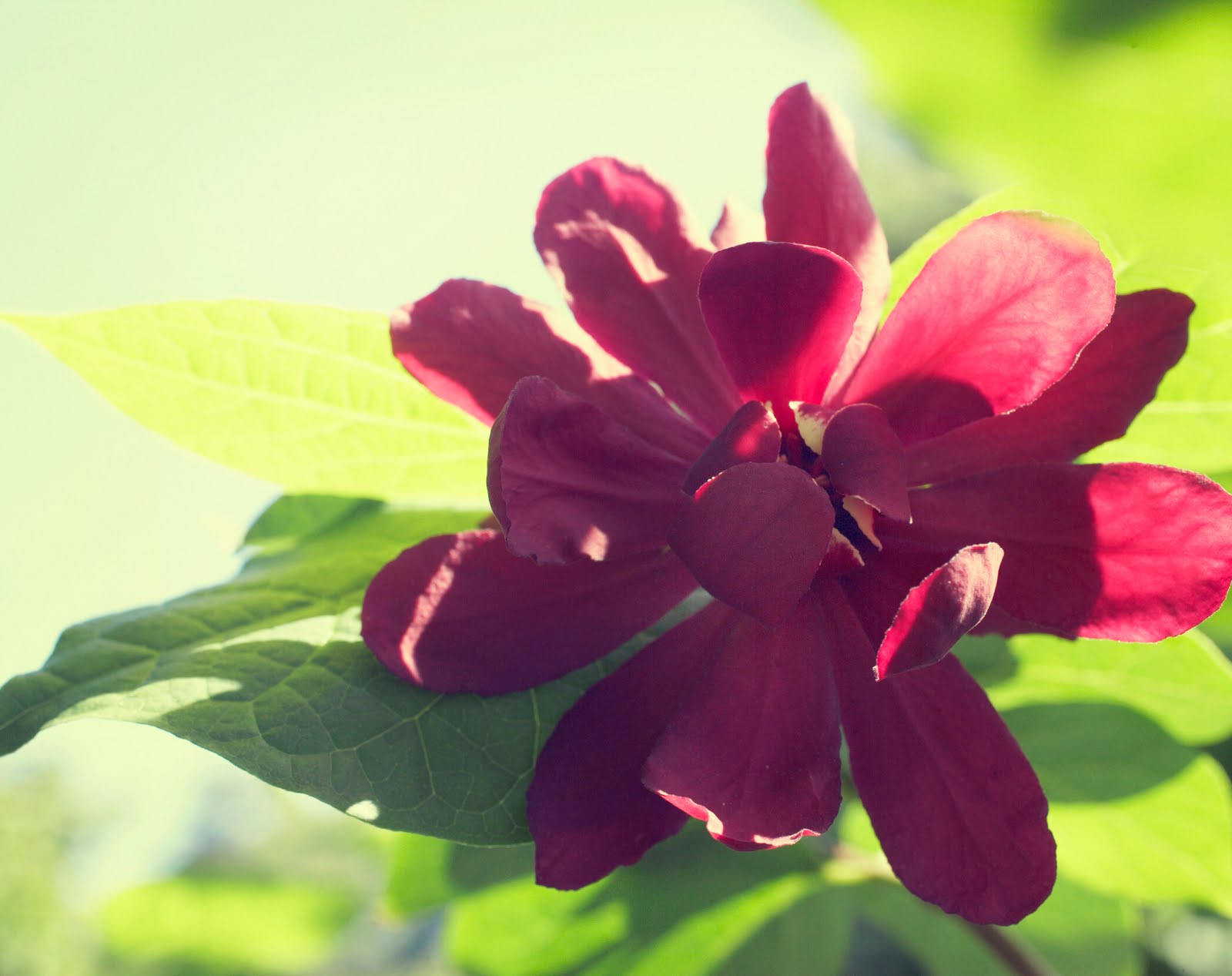
Cranford Rose Garden at the Brooklyn Botanic Garden, June 4

The stifling heat came early this year, forcing all the roses to bloom all at once, a month before their usual designated season. I am happy to be back in the rose garden early in the morning, standing among the blowsy blooms, relishing a moment of coolness before the heat of the day comes stealing in. This will always be my rose garden, my retreat in the last few years, and my heaven.

if there are any heavens my mother will (all by herself) have
one. It will not be a pansy heaven or
a fragile heaven of lilies-of-the-valley but
it will be a heaven of blackred roses

my father will be (deep like a rose
tall like a rose)

standing near my

(swaying over her
silent)
with eyes which are really petals and see

nothing with the face of a poet really which
is a flower and not a face with
hands
which whisper
This is my beloved my

(suddenly in sunlight
he will bow,

and the whole garden will bow)

e e cummings
"i & my parents"
six non lectures

6/3/10

Blurry Beauty

Gowanus Canal

"There's industrial buildings, there's open space, there's blurry beauty everywhere. There's kind of the feeling that you can still discover something special, that you're using your own aesthetic to interpret," David Belt, architect quoted in the New York Times talking about the Gowanus Canal. This is what I love about living where I do.

5/30/10

Summer


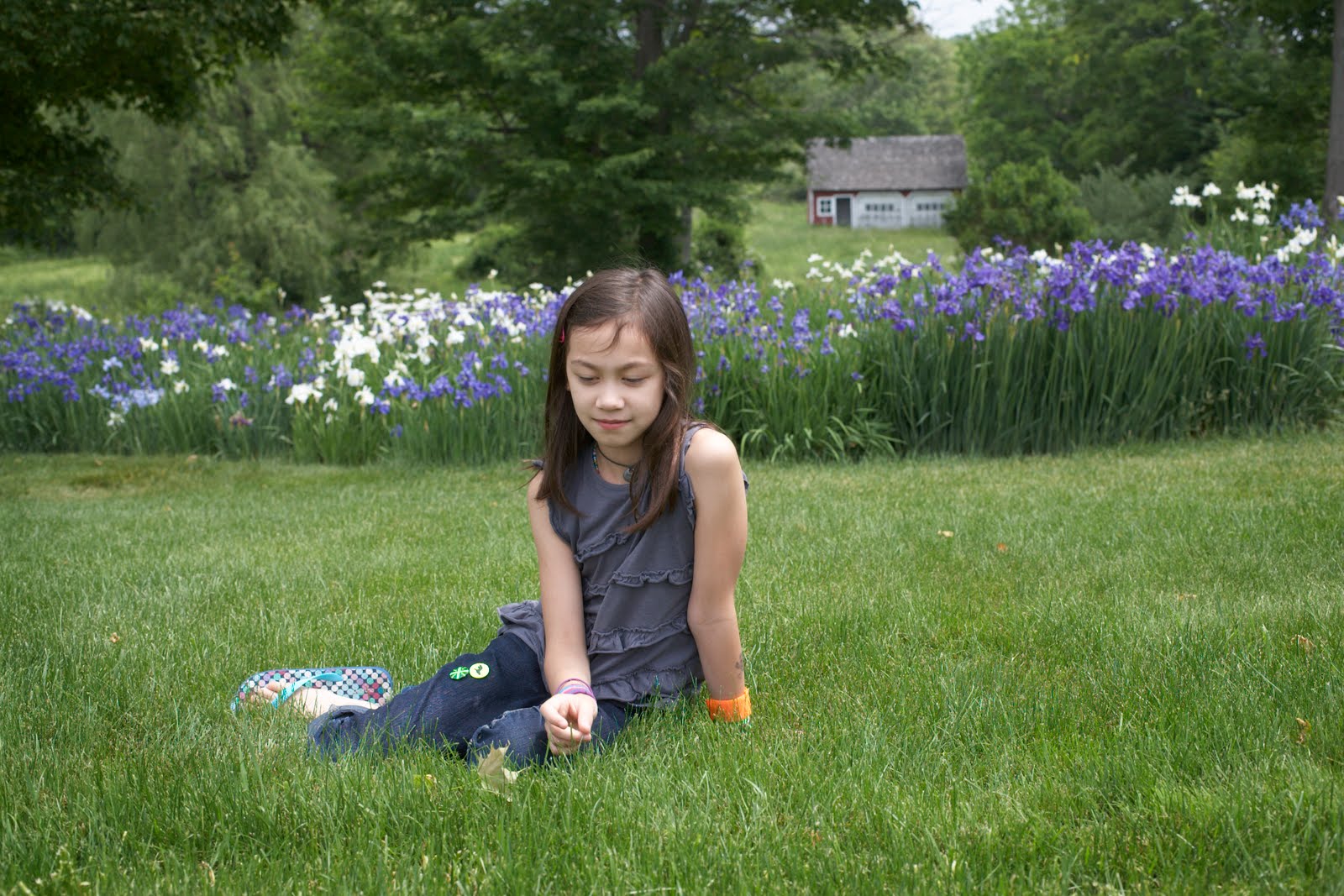
Norfolk, Connecticut.
The start (I hope) to a beautiful summer.

5/25/10

Pleasures


For the first time in months, I was able to spend the morning wandering around the Brooklyn Botanic Garden. It was pure bliss. All my worries and cares fell away, and I was left with the sky, the light, the flowers, and the laughter of children.

Pleasures

A few verses.
A few lines about poetry.
A few sips down the throat
Of something thick and bitter.
The evening lowers its weary bones.
Memory. Silence.
The barely audible tick-tack.
If only there was a summer shower.
My head on someone's navel. Yes!

Radmilla Lazic
(translated by Charles Simic)

5/23/10

The shaggiest garden

Monet photographed on the Japanese bridge at Giverny, 1922
Derek Jarman, photographed by Howard Sooley, on the Japanese bridge at Giverny, 1993

Monet's garden at Giverny is the ultimate artist's garden. Covering almost two hectares, more like a park than a garden, it was used by Monet as an extension of his studio. He was fascinated by botany – he swapped plants with artist friends such as Caillebottte and was on good terms with the chief gardener of the Jardin des Plantes, with whom he had a regular exchange on garden subjects and new species. In the last decades of his life, the garden became the primary subject of his paintings. Writing to Gustave Geffroy in June 1912, Monet stated modestly, "I do what I can to convey what I experience before nature."

Derek Jarman, whose small but no less magical garden at Dungeness is a world away from the watery, lush, and expansive composition of Giverny, was a great admirer of Monet's garden. His final holiday before his death from complications of Aids was to Giverny, a pilgrimage of sort to another artist's creation. In the last book he ever wrote, a moving record of the improbably beautiful garden he had created in the inhospitable landscape of Dungeness–a desolate expanse of shingle facing a nuclear power station–Derek pronounced Monet's garden "the shaggiest garden in the world, only possible to describe in the flecks and dabs of colour in his paintings." This is the highest compliment Derek could bestow on any garden, since in his estimation, "If a garden isn't shaggy, forget it."

5/16/10

Looking at the sky, water and flowers

Monet in his first studio at Giverny

"Nymphéas" (1907)

"Nymphéas" (1908)

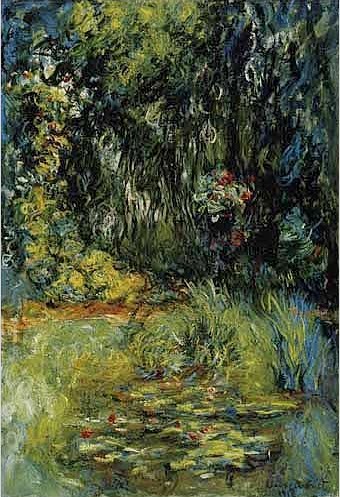
"Les Bassins aux nymphéas" (1917-1919)

"The Water Lily Pond" (1918)

"I have spent nearly eight lazy days looking at the sky, water, and flowers."
Claude Monet, in a letter dated May 14, 1908

Over a hundred years to the day after these words were written in Giverny, I stood in the Larry Gagosian Gallery in Chelsea looking at some of the beautifully complex paintings that Monet produced in the last two decades of his life from his singular way of looking at the sky, water and flowers in his monumental garden. The show reunites for the first time in 101 years the 7 paintings that were part of Monet's 1909 show at the Galerie Durand-Ruel in Paris, one of the last 3 three shows that he staged before his death at 86 in 1926. In the last decades of his life, Monet devoted himself to the making his elaborate garden, which became his muse and model for his paintings. From the collection of 27 paintings gathered in the show, the garden appears in various moods and colors, at times all shimmering and blue, and at other times dark and gnarly, the paint thickened in a turbulence of motion and color. These paintings reinforced Monet's thrust toward abstraction and point at his influence on such Abstractionist as Joan Mitchell and Jackson Pollock. It's one of the most beautiful shows I have seen in a long time. I left the gallery yearning for my own small patch of nature so I can spend my time looking at the sky, water and flowers for the rest of my days.